
Unveiling the past: Balance of payments time series extended back to 1999


15 May 2026
By Bochra Lemsaddak, Antonio Rodríguez Caloca, Aleksandra Skorupinska, Camilla Benagli and Milena Matteo
The ECB has released balance of payments and international investment position backdata estimates for the period 1999-2012. These estimates cover the main current account and the financial account items, both for monthly and quarterly data. This data release:
- provides long time series data for the current composition of the euro area (21 countries);
- incorporates updated national data following the benchmark revisions [1] of 2024.
Backdata are relevant for structural analysis, for instance of the long-term determinants of current account imbalances and the role they play in euro area external developments. Moreover, long time series are required for econometric modelling and hence serve the ECB’s policy areas in regular projections work.
Method
The backdata estimates were produced using a structured approach based on data available to the ECB. [2]
The totals for the current and capital accounts (credits and debits), as well as for the financial account (assets and liabilities, both for transactions and positions) vis-á-vis the rest of the world, are obtained quarterly for each euro area country (including Bulgaria and Croatia) and the euro area institutions (including the ECB). Since most countries had data gaps that required some use of estimates, the ECB followed a sequential approach that prioritised observed data over model-based estimates. When data compiled according to the sixth edition of the IMF’s Balance of Payments and International Investment Position Manual (BPM6) were not available, the ECB used data based on the fifth edition (BPM5). For any remaining gaps, the ECB applied autoregressive integrated moving average (ARIMA) modelling.
After completing the data for all euro area countries, the ECB calculated the euro area aggregates following the regular compilation/aggregation process. The ECB estimated the monthly series using the published monthly “euro area 19” backdata estimates as a reference.
Main results
The newly estimated euro area series (see Charts 1 and 2, series in yellow) aligns smoothly with the currently compiled series for reference periods that runs from 2013 onwards (series in blue). The previous backdata estimates (series in orange) captured the overall trend and level but required updating to improve the fit. The inclusion of Bulgaria and Croatia, together with the benchmark revisions to the euro area backdata, slightly reduced the current account balance, while the net international investment position remained broadly unchanged.
Chart 1
Euro area current account balance
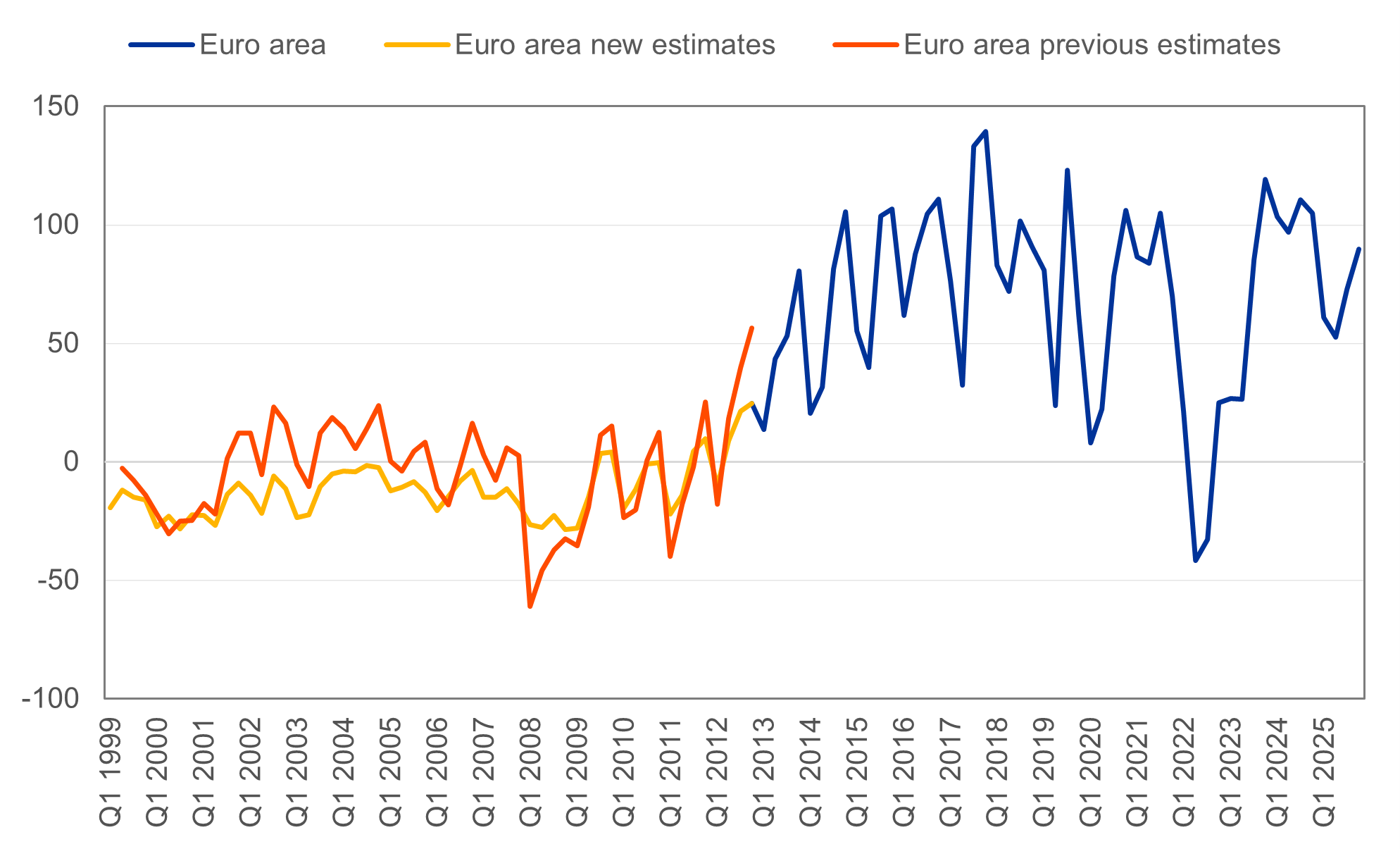
Data for the current account of the euro area
Chart 2
Euro area net international investment position
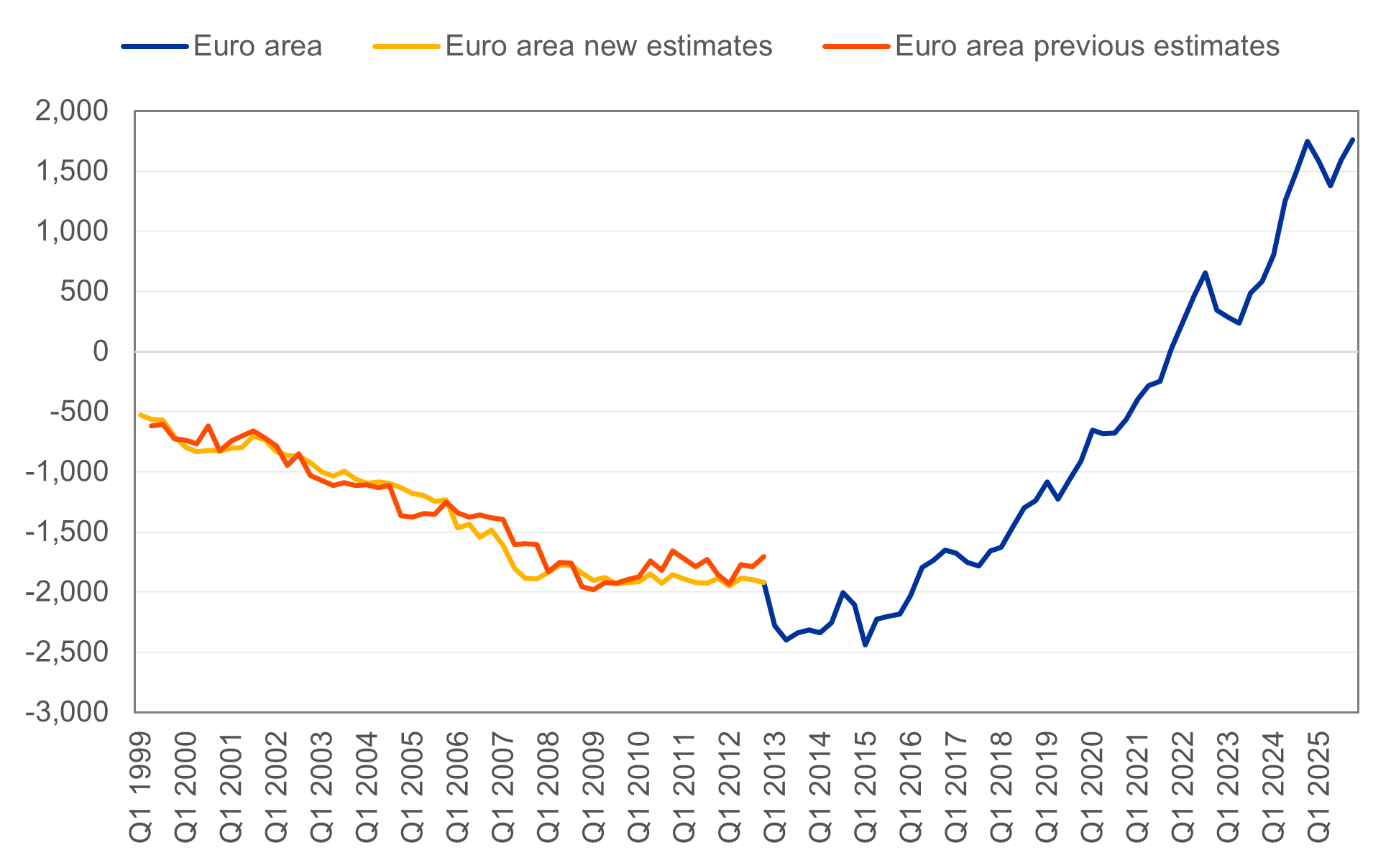
Data for the financial account of the euro area
[1] In 2024 the European Union conducted a coordinated benchmark revision of national accounts and balance of payments data, involving the joint efforts of the European System of Central Banks and the European Statistics System. The revision, which is run every five years, sets out to incorporate new data sources and update statistical methods, ensuring the accuracy and reliability of the underlying macroeconomic indicators.
[2] For more details on the approach previously implemented, see “Estimation of euro area balance of payments and international investment positions: extending the BPM6 series, April 2017”.